
Open Enrollment and SB 101 by
Dr. Louis Esposito, Ed.D. March 24th, 2026
What is SB 101?
On the surface, SB 101 sounds straightforward. Any family in New Hampshire could apply to enroll their child in any public school, not just the one in their town. More choice. More options. What’s not to like?
A lot, it turns out. Especially if your child has a disability.
I spent years in supportive education classrooms before moving into advocacy. First as a paraprofessional and then as a teacher. I helped build the kinds of routines and relationships that make schools work for kids who need consistency to thrive. I watched students struggle when those supports broke down or were not the right ones. I have seen the frustration of supports not being staffed. However, I have watched students soar when the right pieces were in place. As a doctoral researcher, I studied how students with disabilities experience the systems that are supposed to serve them and how it shapes their identity and perspective on themselves and how they view disability.
SB 101 does not close that gap. It widens it. Reaching Higher NH does a great job with explaing all the facts around the challenges that Open Enrollment will bring to NH.
Let’s Be Honest About Where We Are
Supportive education in New Hampshire is not perfect. Far from it. Families fight for services that should be automatic. The system can feel very much compliance driven from the perspective of educators and families. IEP meetings can feel more like negotiations than collaborations. The process can take a lot out of a family and many come out if it frustrated and jaded by the experience. I hear it from families every week and I’ve seen it first hand both as teacher and as a parent.
So I understand the appeal of SB 101. When the system isn’t working, the instinct to look for a way out makes complete sense. Parents shouldn’t have to fight this hard. Students deserve better.
But open enrollment is not the answer. It is a pressure valve on a problem that requires a real fix. Moving students around does not change the conditions that made things hard in the first place. And for students with disabilities, it introduces a whole new set of risks.
Two Districts, One Student, No Clear Answer
Under federal law, when a student has an Individualized Education Program, the home district, the town where the family lives, is legally responsible for making sure that IEP is carried out. That responsibility doesn’t transfer just because the student attends school somewhere else.
So under SB 101, you could have a student sitting in a classroom in one district, with their IEP owned by a completely different district. Two teams. Two sets of administrators. Competing priorities. And when something goes wrong, when a service gets delayed or a support isn’t in place or two districts disagree about who pays for what, there is no clear process in the bill to resolve it.
That is not a small procedural gap. That is a crack right through the foundation of what the law is supposed to guarantee: a Free Appropriate Public Education for every student with a disability. FAPE isn’t just a policy term. It is a civil right. And SB 101 puts it at risk without ever saying so.
What about Students Who have a 504?
The conversation about SB 101 and disability has mostly focused on students with IEPs. But there is another group that deserves just as much attention: students who are protected under Section 504 of the Rehabilitation Act.
504 plans cover students whose disabilities affect their daily functioning in school but who may not qualify for special education services. The range of students who fall into this category is wider than most people think. And the accommodations they require are not always things a school can pull off overnight.
Consider a student who is hard of hearing and uses an FM system. That technology requires a transmitter worn by the teacher and a receiver used by the student. The system has to be calibrated to all the classrooms that student attends. At the elementary level, that can mean a handful, in higher grades, even more. Staff have to be trained on how to use it. If the equipment isn’t available, the student simply cannot access instruction the way the law requires. You cannot improvise an FM system on a Monday morning because a new student walked in on Friday.

Think about a student with a need for sensory processing supports whose 504 requires a designated quiet space in the building, a modified lunch schedule to avoid the chaos of a packed cafeteria, and a specific seating arrangement in every classroom. That is not one conversation. That is a building-wide coordination effort. Teachers need to be briefed. Schedules need to shift. Physical spaces may need to be reorganized. None of that happens the same week a student arrives.
Or think about something as common as a severe peanut allergy. A student whose 504 requires a nut-free classroom doesn’t just need a note in a file. Every student in that class needs to be told. Parents need to be notified about snacks and lunches. The classroom has to be deep-cleaned before the student arrives. The cafeteria needs a designated safe table. Every staff member who interacts with that student needs to know where the EpiPen is, how to recognize anaphylaxis, and exactly what to do in the first three minutes of a reaction. That is not a one-person job. That is a whole-school response that takes days to coordinate properly, even when everyone is trying their best. Now imagine that student transferring in on a Tuesday with no advance notice. The plan exists on paper. But the building isn’t ready. And the consequences of not being ready are not a missed assignment or an uncomfortable day. They are a child going into medical shock in the lunch line.
When a student with a 504 plan transfers to a new district under open enrollment, what happens to that plan? Who reviews it? Who is responsible for implementing it on day one, before anyone in the building knows this student’s history? The bill doesn’t say. There is no transition protocol. No timeline. No named party responsible for making sure that student’s rights travel with them.
This is not just a problem for the student. It is a disruption to the entire school community. Teachers who suddenly need new training. Classrooms that need to be reconfigured. Equipment that needs to be ordered. Schedules that need to change. These are real operational demands that land on already stretched staff with no warning and no additional resources to absorb them.
For a student with a seizure disorder whose 504 specifies exactly how staff should respond during an episode, that gap is not a bureaucratic inconvenience. It is a situation where the wrong response, from a staff member who simply didn’t know, could put a child in serious danger. Every day that a 504 plan sits unimplemented is a day that student’s civil rights are on hold.
Getting There Is Half the Battle

For many families, one of the biggest barriers will be transportation.
Under SB 101, neither the home district nor the receiving district is required to provide transportation for students who transfer. Families are on their own.
For a lot of families, that is a dealbreaker right there. If transportation is written into a student’s IEP as a required service, what happens when that student transfers to a school in a different district? Does the sending district still have to provide a wheelchair-accessible bus across town lines? Who pays for the one-on-one aide on a route that now covers three times the distance? If the cost of that transport doubles or triples, is that the sending district’s burden to carry? And what about Extended School Year programming in the summer, when transportation costs can be even harder to absorb?
Nobody knows. The bill does not say.
Let’s take imaginary students, neighbors even, from Nashua as an example. Instead of having one transport for the both of them to Nashua North, one student enrolls in Bedford and the other enrolls in Londonderry. That would require an additional busing option between the two, going further than before. One going 30 minutes north to Bedford and the other traveling 30 minutes east to Londonderry. So instead of one bus going 10 minutes to Nashua, now you have two travelling further in separate directions. Think about how much more this will cost a district for 180 days of education and potential summer ESY programming.
The Discrimination Nobody Is Talking About
SB 101 includes a list of reasons a district can use to deny a transfer application. On paper, it looks reasonable. A student can be denied if they were previously expelled, if they have a documented history of significant disciplinary issues, if they have a documented history of chronic absenteeism, or if the receiving district does not have available capacity.
Read that list again with a disability lens.
Disciplinary history. Chronic absenteeism. Capacity. Every single one of those categories can be a proxy for disability, and the bill does nothing to prevent them from being used that way.
I have worked with students whose disciplinary records look alarming on paper. Repeated classroom removals. Behavioral incidents that followed them from year to year. But when you looked closely, the pattern was almost always the same story: a student whose disability was poorly understood, whose supports were inadequate, and whose behavior was the only language they had left to communicate that something was wrong. Under SB 101, that student’s file becomes a reason to shut the door.
The same is true for chronic absenteeism. Anxiety disorders. Chronic illness. Depression. Medical conditions that require frequent appointments or recovery time. These are real reasons why real students miss school. They are not character flaws but are disabilities. And a receiving district reviewing an application has no obligation under this bill to ask why a student was absent before checking the denial box.
Capacity makes it worse. Before accepting a student, a receiving district would need to understand whether it can actually serve them. That means, in practice, knowing something about that student’s needs. But a student’s IEP or 504 plan is confidential. A district cannot require access to that information as part of an application. So how does a district make a genuine capacity determination for a student with significant support needs without knowing what those needs are?
The answer is that it cannot which means one of two things happens. Either districts deny students without ever really understanding their needs, which is arbitrary and potentially discriminatory. Or districts find informal ways to access disability information they aren’t supposed to have, and use it to make decisions they aren’t supposed to make.
Neither of those outcomes is acceptable. Both of them are predictable. And the bill is completely silent on how to prevent them.
The Americans with Disabilities Act and Section 504 prohibit discrimination based on disability in any program that receives federal funding. Public schools receive federal funding. That means the denial criteria in SB 101 do not exist in a legal vacuum. They exist in direct tension with federal civil rights law. And yet there is no guidance in the bill, no oversight structure, no appeals process designed to catch discrimination when it happens.
A System Built on Unanswered Questions
There are many things that worry me about SB 101. It is not just one problem. It is the sheer volume of things nobody has figured out yet, combined with the expectation that schools will somehow manage all of it starting July 1, 2026. That’s next school year!
Think about what districts are being asked to absorb. Enrollment numbers that could change at any point. Budgets built on student counts that may shift mid-year. Staffing decisions that have to be made in April for a school population that won’t be known until September.
What happens when a student with significant support needs transfers into a district that has never run a program for those needs? Can a family demand that the receiving district build one? The bill doesn’t say.
What happens when a district runs out of open enrollment slots mid-year and a new family moves into town and needs a seat? The bill doesn’t say.
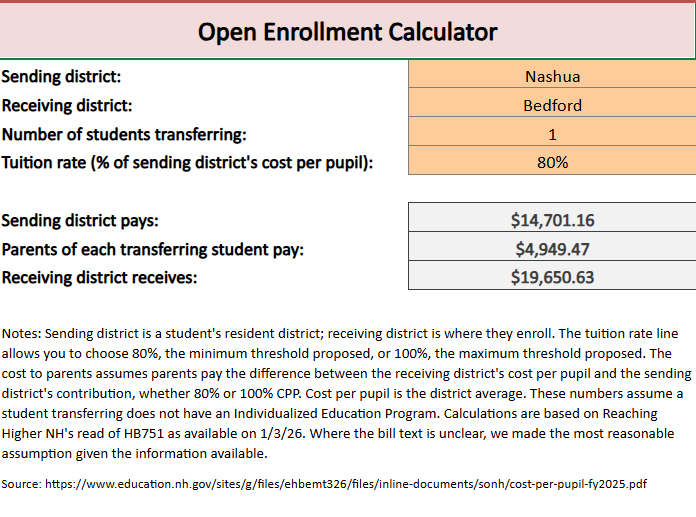
Finally, the cost of Open Enrollment are very complicated and vary between sending district and receiving district. Using Reaching Higher’s Open Enrollment Calculator, sending a student from Nashua to Bedford would cost the Nashua school distict over $14,00 while the family would have to contribute close to $5,000. If that student requires support through an IEP, that can be significantly more leaving the Nashua School District.
What We Actually Need
Local property taxes carry the majority of the burden, which means the quality of your child’s education is deeply tied to the wealth of the town you live in. That is the problem. Open enrollment does not solve it. It shuffles students between schools while leaving the funding gap exactly where it was. NH School Funding Fairness Project does a great job breaking down the complexities of how school funding works here in the Granite State.
Supportive education needs reform. Real reform. The kind that ensures every student gets the services they are legally entitled to without their family having to fight for them. Without the concern of being in the right zip code. Without the practice of hiring expensive advocates to help navigate a system to get the support a child needs. The kind that funds districts adequately so that inclusion is a genuine practice, not a budget line item. The kind that takes the experiences of disabled students seriously, not as a logistical challenge to be managed, but as a matter of equity and human dignity.
SB 101 is not that. It is a major change to how New Hampshire schools operate that is built on a foundation of unanswered questions, implemented on a rushed timeline, with no named authority responsible for making sure the most vulnerable students don’t fall through the cracks.
Our students deserve better than that. Our schools deserve better than that. And frankly, so do the educators who will be left to figure all of this out on their own.
What You Can Do Right Now
This bill affects every school, every family, and every student in New Hampshire. The hearing is Wednesday, March 26 at 1:00 PM in Room 232 at Granite Place in Concord. If you can be there, be there.
If you cannot make it in person, online written testimony is also important.
You can do this by going to the GenCourt NH Website here:https://gc.nh.gov/house/committees/remotetestimony/default.aspx
Fill out your first and last name, town, and email address
Select the hearing date: Wednesday, March 25th
Choose: House Education Policy and Administration Committee
Select: Member of the public (representing yourself). Indicate your position on the bill (support or oppose) Add your testimony:
- Upload a file, or
- Write directly in the box, or
- Leave blank if you prefer
Click Submit
You can also contact the committee or your legislator to ask these questions using the Fast Democracy Campaign Below because we need both answers and actions.